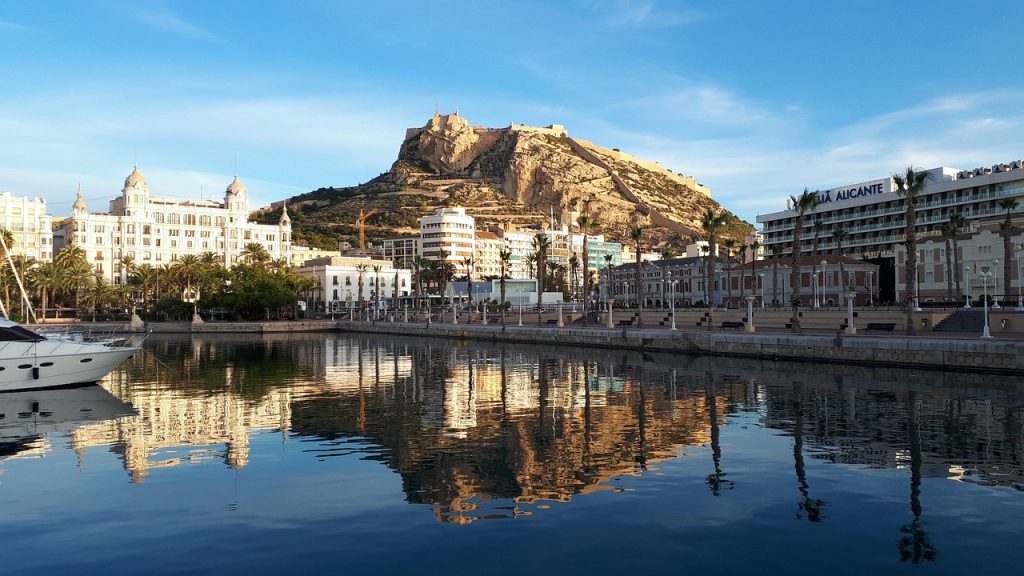
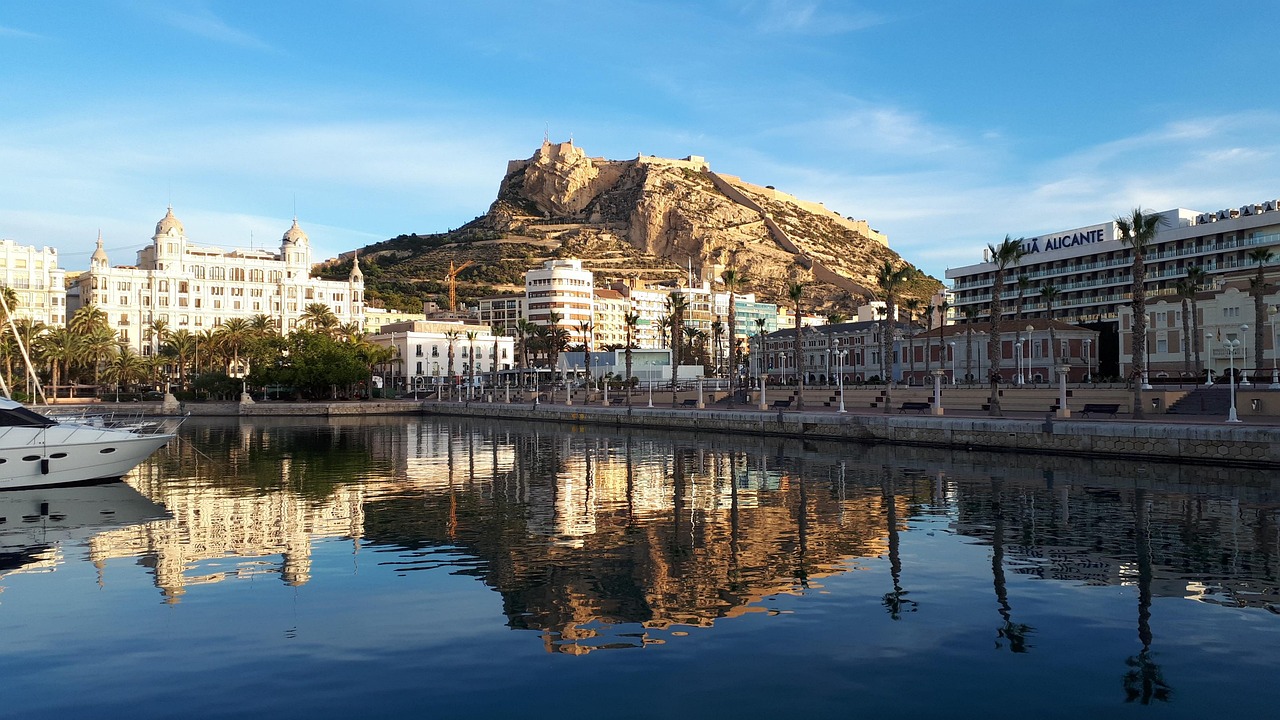
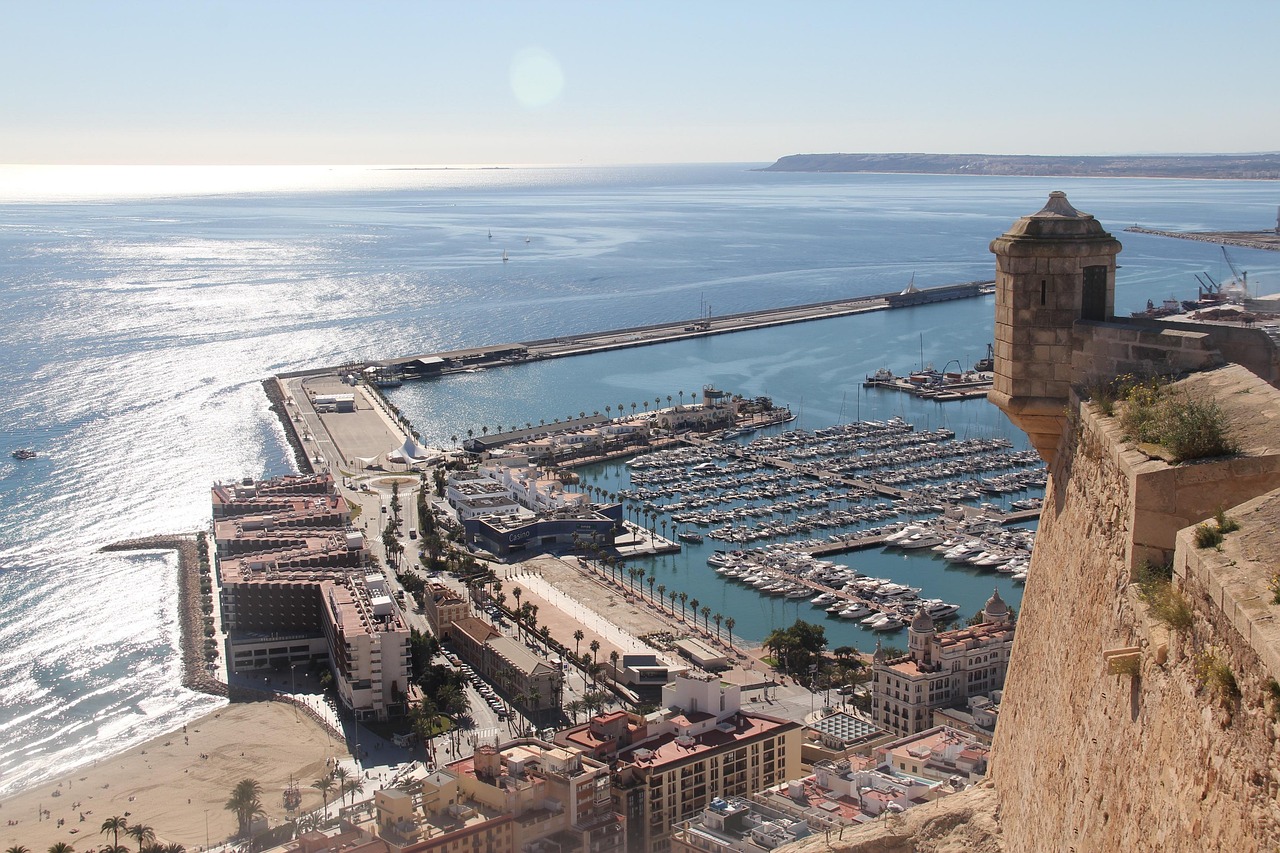
Almost every one-day Alicante itinerary starts in the same place, and for good reason: the Santa Bárbara Castle, on top of Mount Benacantil, 166 m up. Entry is free, and from the top you can see the whole city, the port and the bay.
What few people compare is how to get up. There are three ways up, with very different prices, timetables and effort levels, and choosing well shapes the rest of your day.
In two lines: take the lift up to the castle at 10:00, walk down through the Santa Cruz neighbourhood, reach the Central Market before 14:30, and save the Explanada for the end of the day. Tickets: between €0 and €23.
Is one day enough to see Alicante?
Yes. Alicante’s centre is compact: the castle, the Old Town, the market and the seafront are all within walking distance, with just one real uphill stretch—the climb up Benacantil. And you can handle that without breaking a sweat.
What won’t fit is Tabarca Island. The boat takes almost an hour each way and the return is in the afternoon, so that’s another day. If you only have one, stay in the city.
This is the order we recommend, designed so you go up when the castle has just opened and spend the rest of the day walking downhill:
| Time | Stop | Entrance | Time |
|---|---|---|---|
| 10:00 | Santa Bárbara Castle (up by lift) | Free + €2.70 for the lift | 1 h 15 |
| 11:15 | Walk down through the Santa Cruz neighbourhood | Free | 30-45 min |
| 12:00 | Basilica of Santa María and MACA | €6 / free | 45 min |
| 12:45 | City Hall and the zero elevation point | Free (Mon–Fri, until 14:00) | 15 min |
| 13:15 | Central Market | Free | 45 min |
| 14:00 | Lunch: a rice dish | — | 1 h 30 |
| 16:00 | Co-Cathedral of St Nicholas | €8 | 45 min |
| 16:45 | MARQ (archaeology) or MUBAG (fine arts) | €6 / free | 1 h 15 |
| 18:15 | Rambla, Portal de Elche and Explanada de España | Free | 1 h |
Visit times are our estimate, not official data.
Before continuing, check which day you’re coming. In Alicante, opening hours change more by day of the week than by season:
| Day | What is closed or changes |
|---|---|
| Monday | MARQ, MACA, MUBAG and the Bonfires Museum are closed. The castle and the Co-Cathedral are open |
| Saturday | The City Hall can’t be visited. The Central Market is open until 15:00 and the Co-Cathedral closes at 17:30 |
| Sunday | The Central Market and the City Hall are closed. MARQ, MACA and MUBAG are only open from 10:00 to 14:00, and the Bonfires Museum until 13:30. The Basilica opens from 13:00 and the Co-Cathedral from 13:30 to 17:30. In return, MARQ costs €3 |
| From November 15 | The castle and the lift close at 18:00: the last lift up is at 17:20 |
If you come on Monday, skip MACA and the afternoon museum: spend longer at the Co-Cathedral and strolling around the port. If you come on Sunday, flip the day around: museum in the morning, Basilica and Co-Cathedral after lunch, and the castle mid-afternoon.
Morning: Santa Bárbara Castle (free, but you have to get up there)
Santa Bárbara Castle has free entry and is open every day. From September 5 to November 14, 10:00 to 20:00; from November 15 to February 27, 10:00 to 18:00. Closed on December 24, 25 and 31, and January 1 and 6.
Don’t arrive at the last minute: the City Hall closes access to the grounds half an hour before closing, and the last lift up is 40 minutes before.
Up top is one of Spain’s largest medieval fortresses, with walls and towers. Inside you’ll also find MUSA, the City Museum, with free entry. Allow a good hour to explore it at an easy pace.
Three ways up, compared
| How | Price | From where | What you need to know |
|---|---|---|---|
| Lift | €2.70 | Opposite Postiguet Beach (Av. Juan Bautista Lafora) | Last lift up 40 min before closing. Buying your ticket in advance is recommended. Free for retired pensioners with proof |
| CSB shuttle | €1.45 each way | Puerta del Mar, Postiguet footbridge, or the TRAM stop MARQ-Castillo | Debit card or bonobús only |
| On foot | Free | La Ereta Park, from the Old Town | Official circular route of 1,600 m and one hour, with sections at a 20% gradient |
All three are published by the City Hall on the castle’s page and on the Alicante Turismo site. The walking-route info comes from the City Hall brochure for La Ereta.
Our advice: go up by lift and walk down. The tiring part is the climb, and walking down through La Ereta and Santa Cruz doesn’t just save you the effort: you end up right in the Old Town, next to the next stop. Walking up and taking the lift down, on the other hand, drops you at Postiguet Beach, and you miss the descent through Santa Cruz.
Mid-morning: walk down through the Santa Cruz neighbourhood
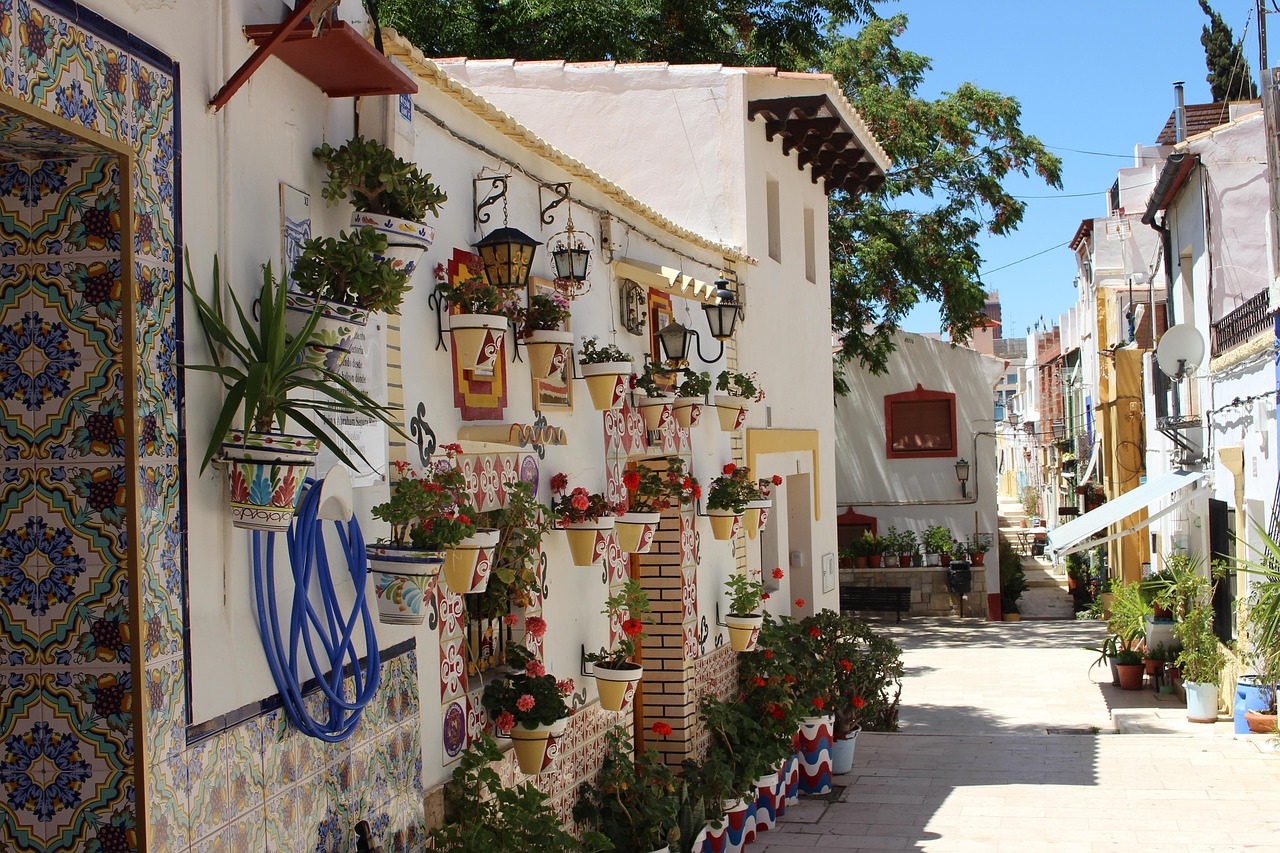
From the castle, the route goes down through La Ereta Park to the Santa Cruz neighbourhood, the whitewashed quarter clinging to the Benacantil hillside: stairways, tiles and flowerpots hanging from every façade.
It’s a neighbourhood where people live, not a set. It takes about half an hour to walk through if you take it easy on the way down. If you pass someone watering the pots, that’s exactly what keeps the neighbourhood feeling like a real neighbourhood.
Midday: the Basilica, the zero elevation point and the Central Market
At the foot of Santa Cruz is the Basilica of Santa María, built in the 14th century on the site of the city’s former main mosque. The visit costs €6 with an audio guide included (€5 for over-65s), Monday to Saturday from 10:00 to 19:00, and Sunday from 13:00 to 19:00.
Right opposite, in the same square, is the MACA, the contemporary art museum, which is free. Its 20th-century art collection was donated by Alicante native Eusebio Sempere and includes works by Picasso, Miró, Dalí, Chagall and Calder. Twenty minutes is enough for the highlights.
The “zero elevation point” isn’t at zero metres
A few steps away, heading down towards the sea, is the City Hall. At its entrance is the National Altimetric Reference, the starting point for official elevations on the Iberian Peninsula: a bronze disc called NP1, on the first step of the main entrance.
They call it the zero elevation point, and it’s often described as the point that marks sea level. That’s not exactly true: according to the National Geographic Institute, NP1 is at 3.4095 m above mean sea level in Alicante, measured in 1874. Zero is the sea; the step is the reference. The City Hall can be visited for free Monday to Friday from 9:00 to 14:00 between October and June.
The Central Market, before it closes
The Central Market is open Monday to Friday from 7:00 to 14:30, and Saturdays and the day before public holidays from 7:00 to 15:00. Closed on Sundays. Some published itineraries send you in mid-afternoon, and at that time you’ll find the shutters down.
This is a real food market, and the place to see what Alicante eats: salt-cured fish, mojama, fish and vegetables. It’s the perfect stop before lunch.
Afternoon: the Co-Cathedral and a museum
Spend the first part of the afternoon indoors. Start with the Co-Cathedral, which closes at 17:30 on Saturday and Sunday, then continue with a museum:
| What | Price | Hours | For whom |
|---|---|---|---|
| Co-Cathedral of St Nicholas | €8 (cultural visit: cloister and museum) | Oct–Apr: Mon–Fri 10:30–19:00, Sat 10:30–17:30, Sun 13:30–17:30 | For its 15th-century Gothic cloister, older than the church itself |
| MARQ (Archaeological Museum) | €6 (€3 on Sundays and public holidays) | Tue–Sat 10:00–19:00, Sun 10:00–14:00, closed Mondays | The city’s main museum. Next to the TRAM stop MARQ-Castillo |
| MUBAG (Fine Arts) | Free | Tue–Sat 10:00–20:00, Sun 10:00–14:00, closed Mondays | Fine arts in the Gravina Palace, right in the Old Town |
If you only have time for one museum, MARQ is the one most worth the detour. If you’re on a tight budget, MACA and MUBAG are free.
The Bonfires Museum, on the Rambla, is also free, but on weekdays it closes from 13:30 to 17:00 and at weekends it only opens in the morning: it fits best at the end of the day, until 19:30, or on another day.
When you leave, walk down the Rambla to the Portal de Elche, with its ficus trees, and Gabriel Miró Square. They’re the natural route towards the sea.
End of the day: the Explanada, the port and Postiguet
Finish on the city’s most iconic promenade. The Explanada de España is a palm-lined walkway over a wavy, three-colour marble mosaic: according to Alicante Turismo, 6.6 million tesserae.
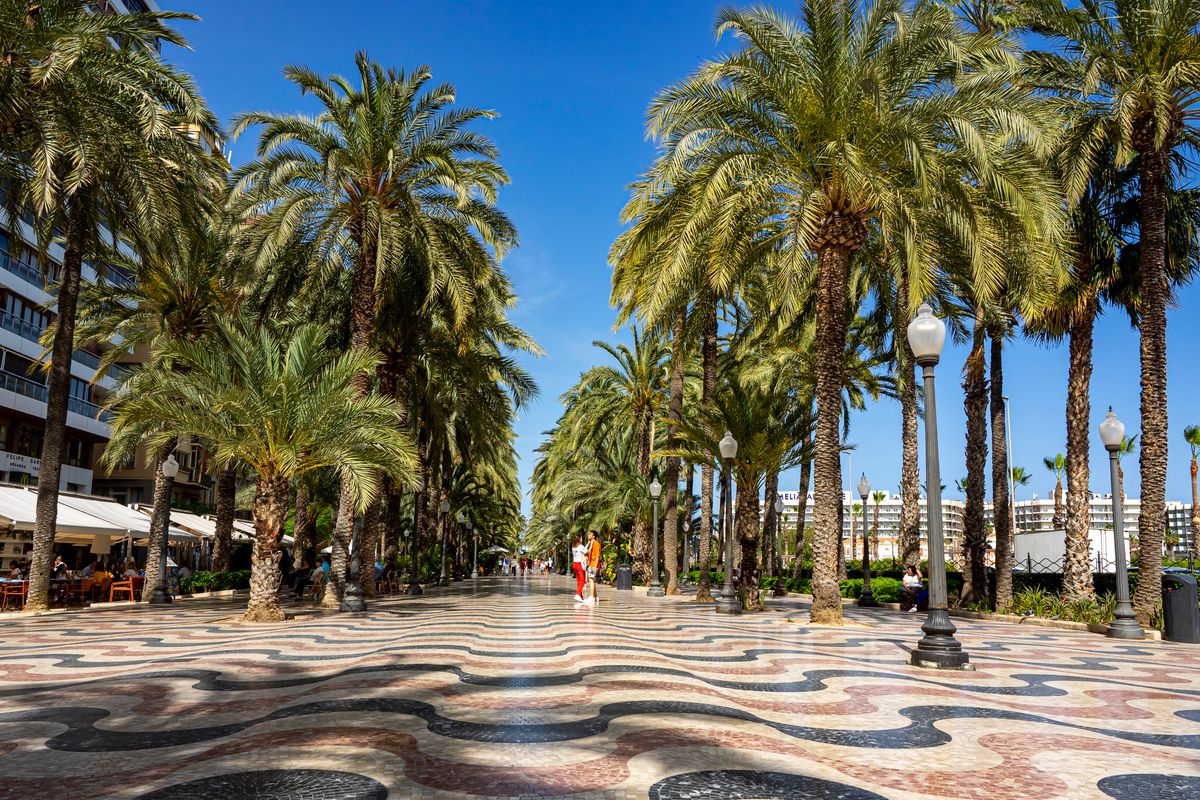
At one end is the Casa Carbonell, the white domed building that appears in every photo. From there, the marina is on one side and Postiguet Beach, with the castle above it, on the other.
If there’s still daylight, look up again from Postiguet: the silhouette of Benacantil with the castle on top is the photo that ends the day.
How much does it cost to see Alicante in one day?
Between €0 and €23 per person in entry fees, depending on what you choose. Here’s the total using prices checked on official websites in September 2026:
| Plan | What’s included | Total in tickets |
|---|---|---|
| Minimum | Castle, walking up. Santa Cruz, MACA, MUBAG, the Market and the Explanada: free | €0 |
| Comfortable | Same as above, taking the lift up to the castle | €2.70 |
| Balanced | Lift + Basilica of Santa María + MARQ | €14.70 |
| Complete | Same as above + Co-Cathedral of St Nicholas | €22.70 |
Alicante is cheap to visit: the main attraction, the castle, is free. What costs money is getting up there—and even that is free if you’ve got the legs and an hour.
If you arrive in Alicante on a cruise: what to see on a port call
More and more people are discovering Alicante from a ship. The port ended 2025 with 252,317 cruise passengers, 7.5% more than in 2024, and between January and August 2026 it had already reached 191,686, 11.2% more than in the same period the previous year, according to the Port Authority.
And autumn brings activity: the port’s port-call calendar forecasts 33 calls between October and December 2026, 17 of them in October. On October 15, three ships coincide on the same day.
From Pier 14 to the centre
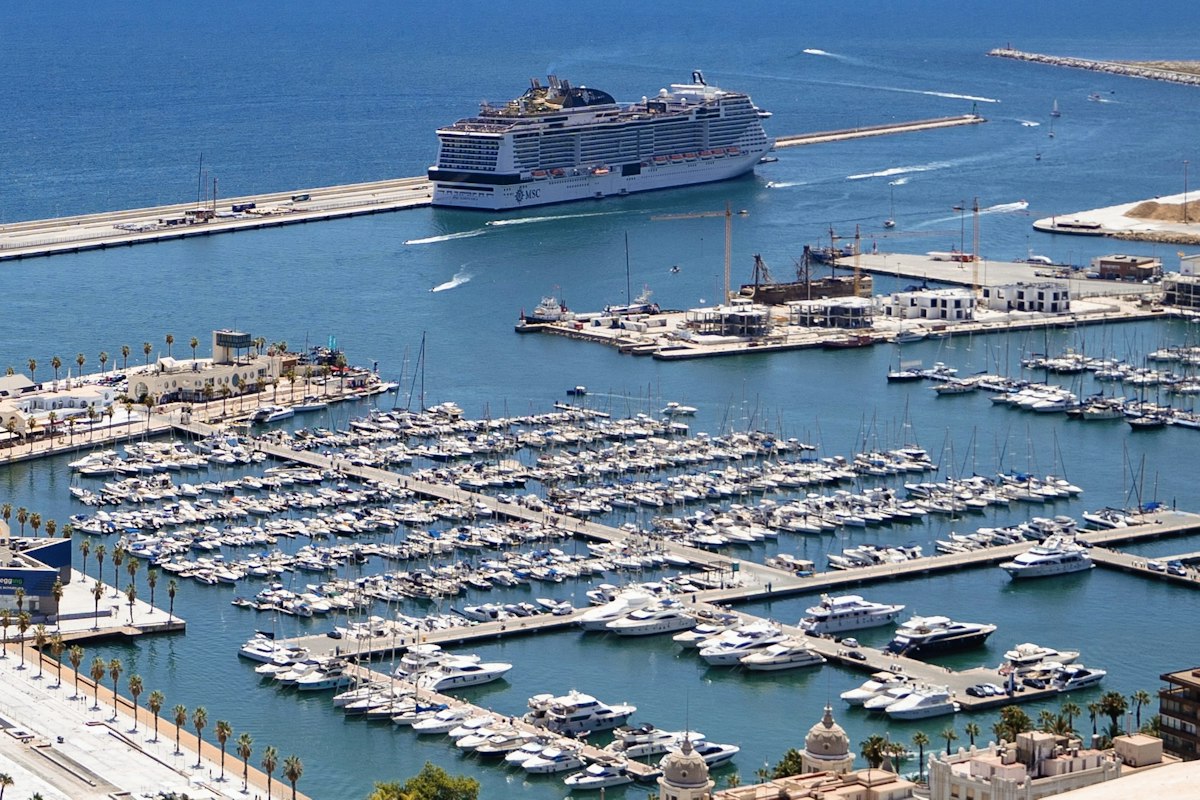
Cruise ships dock at the Pier 14 terminal. It’s 1 km from the centre according to the terminal operator and around 2 km from City Hall according to the City Council Convention Bureau: you can walk along the port to the Explanada. The operator advertises a shuttle service; ask on board whether it’s running that day.
The time that matters is the all aboard time set by your cruise line, not the ship’s departure time. Count backwards from there.
What you can see depending on your hours ashore
| Time Ashore | Plan |
|---|---|
| 3–4 hours | Explanada, lift up to the castle, walk down through Santa Cruz, and back to the port along the promenade |
| 5–6 hours | Same as above + Basilica of Santa María and the Central Market (weekdays until 14:30, Saturday until 15:00; closed on Sunday) + a rice dish |
| 7–8 hours | Same as above + MARQ or the Co-Cathedral, and some time at Postiguet before boarding |
If several ships coincide that day, go up to the castle at 10:00 as soon as it opens, or reverse the order: Santa Cruz and the market first, and the castle after lunch.
If your cruise also stops at other ports in the Spanish Mediterranean, we have the same plan for a cruise stop in Valencia, a stop in Palma de Mallorca and a stop in Málaga.
If you have extra time: Tabarca Island
Tabarca Island is the classic boat trip from the city. The operator Cruceros Kontiki charges €24 return, with journeys of 45 to 60 minutes. On weekdays it leaves Alicante at 9:45, 10:45 and 12:15, and the return from the island is at 16:00 or 17:30.
The small print: the operator warns that timetables can change without notice, so confirm them beforehand. And don’t try to squeeze it into your city day: Tabarca is a separate day.
Alicante in October and November: what the weather is like
Autumn is a great time to visit Alicante. According to the climate normals from AEMET for the city station (1981–2010), October has an average high of 24.9°C and an average low of 14.5°C, with 217 hours of sunshine and an average of 4.5 rainy days. In November, the average high is 20.5°C, with 173 hours of sunshine.
In other words: it’s comfortable to walk at any time of day, which isn’t the case in summer. The warning is rain: September is the wettest month of the year in Alicante, with an average of 56 mm, and October is close behind. If you see a storm warning, swap the castle for a museum and leave it for the next day.
And watch out for November 15: that’s when the castle switches to closing at 18:00. If you’re coming in late autumn, don’t leave the climb until the last minute.
What to eat in Alicante
Alicante was Spain’s Gastronomy Capital in 2025, and it has its own cuisine. Three things are undeniably local:
- Rice. It’s at the heart of Alicante cuisine, according to Alicante Turismo, and the city promotes it with the Alicante Ciudad del Arroz seal. A classic is arroz a banda, cooked in fish broth and served with the fish separately, a banda.
- Cocas. A base of flour, oil and water with tuna, sardines or vegetables on top. The tuna one, coca amb tonyina, is the one eaten during the Bonfires of San Juan.
- Salt-cured fish. Mojama, tuna roe and other salt-cured fish, finished with a drizzle of olive oil. It’s what you’ll see at the stalls in the Central Market.
And a note about turrón: the hard one with the Protected Geographical Indication Turrón de Alicante can only be made within the municipality of Jijona, a few kilometres from the city. You buy it in Alicante, but it’s made there.
How to get around and how to get to Alicante
- TRAM: single ticket for one zone, €1.45 according to the official TRAM fares. The MARQ-Castillo stop drops you next to the museum and at one of the castle shuttle stops.
- To the castle: lift from Postiguet (€2.70) or CSB shuttle (€1.45), as in the table above.
- From the airport: the C-6 line connects the terminal with the centre every day, stopping at the train station and linking with the TRAM at Luceros and Alfonso X el Sabio. A single ticket costs €4.60 according to El Español (October 2025); confirm when you board.
- By train from Madrid: around 2 hours 20 minutes from Chamartín to Alicante Terminal with OUIGO, among other operators.
On foot, it’s a short, flat walk from the Central Market to the Explanada. The only real uphill stretch is the climb to the castle.
How to get between stops without walking
This is where we come in. Between the port, the centre and the Old Town there are several stretches you can do without walking. To get up to the castle, the lift is still the most direct option.
We are not a sightseeing tour company. We offer electric tuk-tuk transport with a host driver: we take you from one point to another, point out what you’re seeing, and recommend where to continue on your own.
- 70-minute tuk-tuk route: from the Explanada to the Santa Cruz neighbourhood and the Basilica of Santa María, with the highlight at Santa Bárbara Castle.
- Private tour: more than an hour, just for your group (up to 4 people per vehicle) and at your pace.
- All our Alicante tours, with departure points and timetables.
Shall we book it? Check availability in Alicante or call +34 695 85 77 68.
Other cities, same format
If Alicante is one stop on a longer trip, we have a one-day plan for four other cities:
- What to see in Valencia in 1 day — old town, City of Arts and Sciences, and beach.
- What to see in Málaga in one day — the Alcazaba, Cathedral, Picasso and Gibralfaro.
- What to see in Ronda in one day — El Tajo, Puente Nuevo and the walk down to the river.
- What to see in Seville in one day — with a plan to dodge the heat.
Frequently Asked Questions
Can you see Alicante in one day?
Yes. Alicante’s centre is compact: in one day you can fit in Santa Bárbara Castle, the Santa Cruz neighbourhood, the Basilica of Santa María, the Central Market, a museum and the Explanada. What won’t fit is Tabarca Island, which needs a day of its own.
How much does it cost to enter Santa Bárbara Castle?
Entry is free. What you pay for is getting up there: the lift costs €2.70 and the CSB shuttle bus costs €1.45 each way. Walking up is free. From September 5 to November 14 it’s open from 10:00 to 20:00, and from November 15 it closes at 18:00.
Where is the lift to Santa Bárbara Castle?
Opposite Postiguet Beach, on Avenida Juan Bautista Lafora. The ticket costs €2.70 and it’s recommended to buy it in advance on the castle website. The last lift up is 40 minutes before closing.
How long does it take to walk up to the castle?
The City Hall’s official route through La Ereta Park is circular, 1,600 metres and one hour, with sections at a 20% gradient. That’s why we recommend going up by lift and walking down: the hard part is the climb.
Which museums are closed on Mondays in Alicante?
MARQ, MACA, MUBAG and the Bonfires Museum are closed on Mondays. Santa Bárbara Castle is open every day, so Monday is a good day to focus on the castle, Santa Cruz and the Explanada.
What typical food should you try in Alicante?
Rice, which is at the heart of Alicante cuisine, with arroz a banda as a classic; cocas, like the tuna coca eaten during the Bonfires; and salt-cured fish, like mojama. The turrón with Protected Geographical Indication is made in Jijona, a few kilometres from the city.
Can you walk from the cruise terminal to Alicante city centre?
Yes. The terminal is at Pier 14, 1 km from the centre according to the terminal operator and around 2 km from City Hall according to the City Council Convention Bureau. The walk follows the port to the Explanada.
What to see in Alicante on a cruise port call?
With 4 hours: lift up to the castle, walk down through Santa Cruz, and the Explanada. With 6: add the Basilica of Santa María and the Central Market, which closes at 14:30 on weekdays, at 15:00 on Saturdays, and doesn’t open on Sundays. With 8: add MARQ or the Co-Cathedral and Postiguet Beach.
Is it worth going to Tabarca if I only have one day in Alicante?
No. The boat takes 45 to 60 minutes each way and costs €24 return with the Kontiki operator, and the return from the island is at 16:00 or later. It takes up the whole day. If you have two days, yes: use the second for Tabarca.
What’s the weather like in Alicante in October?
Mild. According to AEMET climate normals (1981–2010), October’s average high is 24.9°C and the average low is 14.5°C, with 217 hours of sunshine and an average of 4.5 rainy days. In November the average high drops to 20.5°C.
Written by Pep Mora, from WalkTuk. Prices and opening hours were checked on the official websites of each monument and operator in September 2026, except the Central Market hours (City Hall listing from 2023) and the C-6 line fare (press, October 2025); confirm before your visit, as they change.